
- About Us
- |
- Products
- |
- Contact Us
- |
-
- English
- |
- Inquiry List
- |
- Sign In or Sign Up
Dimensional Accuracy Requirements for High-Flow Filter Plastic Parts
High-flow filter plastic parts are core structural components of industrial filtration systems, widely applied in water treatment, chemical processing, pharmaceutical manufacturing and food beverage industries. Unlike conventional filter components, high-flow plastic filters feature large flux, low resistance and long service life, and their dimensional accuracy directly determines assembly tightness, filtration stability and pressure resistance of the entire filter system. Minor dimensional deviations can cause media leakage, flow channel blockage, structural deformation or even system failure under high-pressure operating conditions. Therefore, standardized and rigorous dimensional accuracy control is a fundamental guarantee for the reliable performance of high-flow filter plastic parts.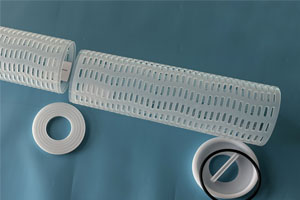
The dimensional accuracy requirements for high-flow filter plastic parts are formulated based on international molding tolerance standards such as ISO 20457 and DIN 16742, which differ significantly from metal parts due to the inherent shrinkage and deformation characteristics of plastic materials. The core accuracy indicators cover outer and inner diameter tolerance, concentricity, flatness of welding surfaces, rib spacing and overall structural straightness. For mainstream high-flow filter cartridges of 20-inch to 40-inch specifications, the basic dimensional tolerance is strictly controlled within ±0.05 mm to ±0.20 mm. Key matching dimensions including inner and outer diameters adopt tighter tolerance levels, while non-assisting structural dimensions allow reasonable deviation ranges to balance manufacturing cost and performance.
Concentricity and structural uniformity are the most critical accuracy indicators for high-flow filter plastic parts. The plastic support cage of high-flow filters adopts helical or longitudinal rib structures to support pleated filter media. Uneven rib spacing or eccentric inner and outer circles will lead to inconsistent stress distribution on filter media, causing local pleat pinching and creasing. This not only reduces the effective filtration area and overall flow rate but also induces media damage under long-term pressure surge and vacuum working conditions. Standard production requires the concentricity error of filter cylindrical parts to be less than 0.1 mm, and rib spacing deviation to be controlled within ±0.3 mm, ensuring uniform flow distribution and stable structural support.
Dimensional accuracy also plays a decisive role in component assembly and welding quality. High-flow filter plastic parts are mostly connected via infrared welding, hot plate welding and ultrasonic welding, all of which rely on precise fitting of contact surfaces. Excessive flatness deviation or dimensional mismatch of welding interfaces will result in unstable welding gaps, insufficient fusion strength and residual gaps, causing liquid leakage and reducing filtration precision. Meanwhile, accurate overall dimensions ensure perfect compatibility with standard filter housings, realizing modular assembly of multi-specification filter cartridges and improving the versatility and interchangeability of parts.
Plastic material shrinkage and injection molding process fluctuations are the main factors affecting dimensional accuracy. Common PP and modified plastic materials for filter parts have thermal shrinkage characteristics, prone to warping and deformation during cooling and molding. To stabilize dimensional accuracy, manufacturers need to adopt mold flow simulation optimization to compensate for material shrinkage errors, and implement precision injection molding processes. In terms of quality control, enterprises shall establish a complete inspection system including First Article Inspection (FAI), in-process sampling and full-key-dimension detection with Coordinate Measuring Machines (CMM). Statistical Process Control (SPC) is applied to track dimensional variation in real time, eliminating batch dimensional defects.
In conclusion, dimensional accuracy is the core technical index restricting the performance and service life of high-flow filter plastic parts. Reasonable tolerance formulation, strict process control and precise detection means are essential to ensure structural stability, assembly accuracy and filtration efficiency of filter parts. With the upgrading of industrial filtration requirements, higher standards for dimensional accuracy of high-flow filter plastic parts will become an inevitable trend, providing reliable technical support for high-efficiency and stable operation of modern filtration systems.